
In the phase I/II ARROS-1 study, zidesamtinib showed clinically meaningful activity in tyrosine kinase inhibitor (TKI)-naïve patients with advanced ROS1-positive non-small cell lung cancer (NSCLC), with an objective response rate (ORR) of 94%.
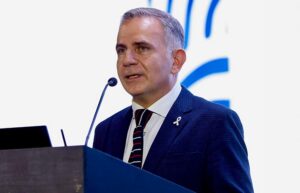
Researcher Alexander Drilon, MD, Chief of the Early Drug Development Service and Attending Physician of the Thoracic Oncology Service at Memorial Sloan Kettering Cancer Center, presented the findings during the second Presidential Symposium at the 2026 World Conference on Lung Cancer on September 14.
US FDA-approved frontline TKIs for locally advanced or metastatic ROS1-positive NSCLC have significant limitations, including limited central nervous system (CNS) activity and dose-limiting side effects. Zidesamtinib was designed to maximize ROS1 activity, ROS1 mutant activity, and brain penetrance, while minimizing tropomyosin-related kinase (TRK) inhibition.

Presidential Symposium 2
Zidesamtinib in ROS1+ NSCLC
Registered WCLC 2026 attendees can watch Presidential Symposium 2 with on-demand access to session recordings via the virtual platform. WATCH NOW
Dr. Drilon said the global, first-in-human ARROS-1 trial included a phase II cohort of patients with locally advanced or metastatic ROS1-positive NSCLC who were naïve to TKI therapy. Patients may have received one prior line of chemotherapy, with or without immunotherapy.
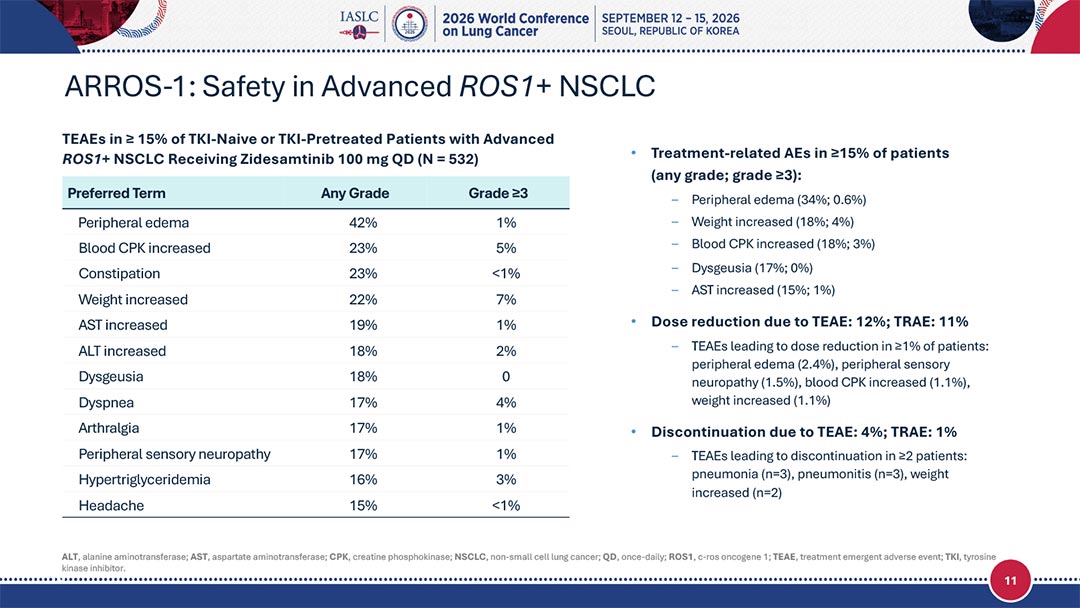
As of April 2026, 629 patients had enrolled in the trial. The current safety dataset includes 532 patients with advanced ROS1-positive lung cancers who received the recommended dose of 100 mg of zidesamtinib daily, regardless of therapy line. Of these patients, 183 were ROS1 TKI-naïve.
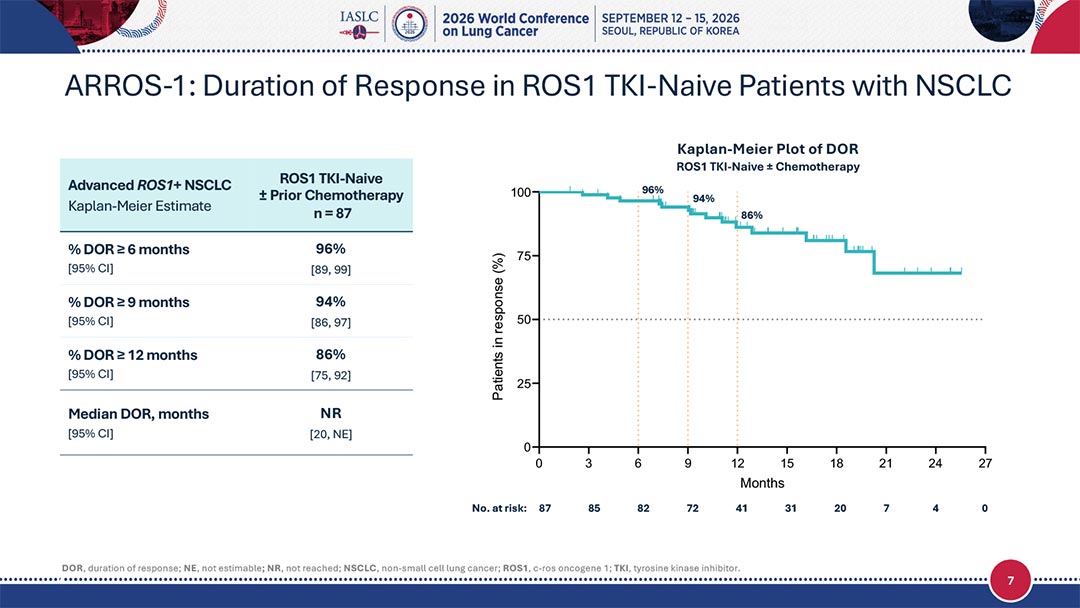
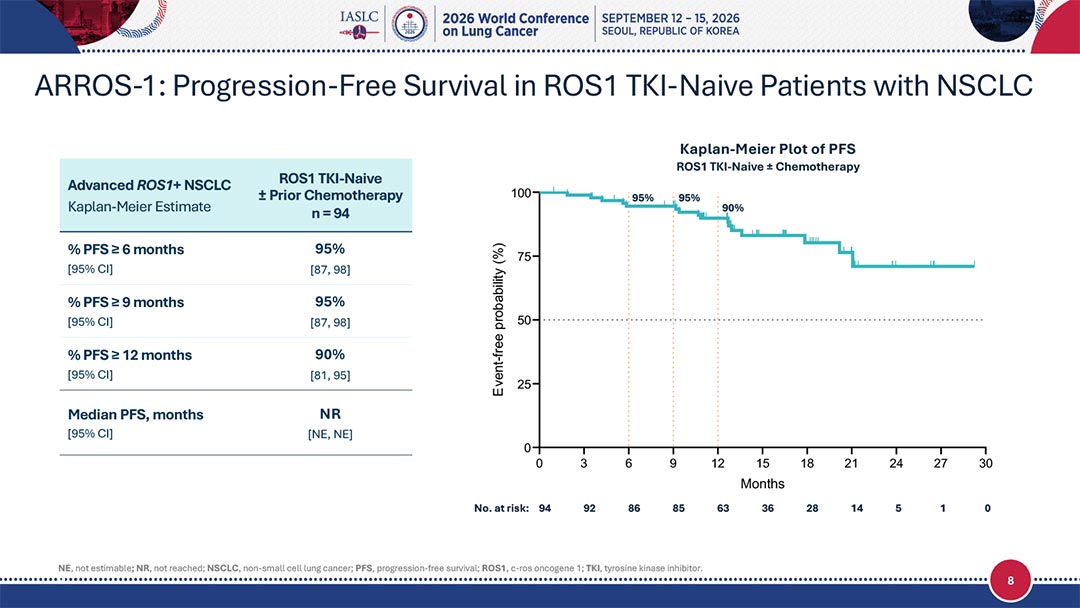
At a median duration of follow-up of 15.2 months, Dr. Drilon said the objective response rate was 94%, and the complete response rate was 15%. The median duration of response (DOR) at 6, 9, and 12 months was 96%, 94%, and 86%, respectively. The median progression-free survival (PFS) was not reached. PFS was 95%, 95%, and 90% at 6, 9, and 12 months, respectively, he said.
While the number of evaluable patients was small, Dr. Drilon said the CNS response findings are promising.
“The CNS response-evaluable population of 10 patients was comprised of patients with measurable baseline lesions by blinded independent central review (BICR) and no radiation within two months of zidesamtinib initiation,” he said. “All 10 patients had an intracranial (IC) response to therapy, and seven out of 10 had an intracranial complete response.”
The median IC-DOR was not reached. The IC-DOR was 100%, 100%, and 78% at 6, 9, and 12 months, respectively. Dr. Drilon said no CNS progression events were observed among the 78 ROS1 TKI-naïve patients who entered the study without brain metastases at baseline, per BICR.
The most common treatment-emergent adverse events (TEAEs) of any grade were peripheral edema, increased blood creatine phosphokinase (CPK), constipation, and weight gain. The majority of these TEAEs were grade 1 or 2. Dose reductions and discontinuations related to TEAEs occurred at a low rate of 12%.
“The drug had a manageable safety profile in this updated data set with relatively low rates of neurological side effects consistent with the drug’s design intent of minimizing TRK inhibition, when possible,” Dr. Drilon said.
Earlier this year, the US FDA approved zidesamtinib for adult patients with locally advanced or metastatic ROS1-positiveNSCLC who received a prior ROS1 TKI based on data from the ARROS-1 study.
In her discussion of the ARROS-1 trial, Associate Professor Malinda Itchins, MBBS, PhD, University of Sydney, said that while zidesamtinib may have raised the bar in frontline treatment of advanced ROS1-positive NSCLC, until the ARROS-1 data matures, taletrectinib remains the benchmark for PFS at 46.1 months.