Editor’s Note: During Presidential Symposium 1, data from a second trial exploring a B7-H3-directed antibody-drug conjugate were presented. The phase 3 ARTEMIS-008 trial showed risvutatug rezetecan also significantly improved overall survival in relapsed small-cell lung cancer. Look for more details in a future issue of WCLC News.
Relapsed small cell lung cancer (SCLC) remains a highly aggressive disease with limited treatment options and poor outcomes following first-line immunotherapy and platinum-based chemotherapy. While topotecan has long been considered the standard second-line option, survival benefit remains modest, and it causes significant hematologic toxicity.
In preclinical and phase I and II studies, tambotatug pelitecan (tam-peli, YL201)—a novel anti-B7-H3 antibody-drug conjugate (ADC)—has demonstrated promising activity in relapsed SCLC. Recent results from the Chinese TAISHAN-302 study suggested that tam-peli could offer a new standard of care for patients with relapsed SCLC;
Li Zhang, MD, Sun Yat-sen University Cancer Center, Guangzhou, China, presented the interim analysis results from the randomized phase III TAISHAN-302 trial during Presidential Symposium 1 at the 2026 World Conference on Lung Cancer (WCLC) in Seoul, Republic of Korea. The study evaluated tam-peli versus topotecan as a second-line treatment for patients with relapsed SCLC.
Registered WCLC attendees can watch the session on-demand via the virtual platform.

Presidential Symposium 1
Tam-Peli vs. Topotecan in Relapsed SCLC
Registered WCLC 2026 attendees can watch Prof. Li Zhang and other presenters with on-demand access to session recordings from the Presidential Symposium 1. LEARN MORE
The trial enrolled 451 patients with relapsed SCLC following one prior line of immunotherapy and platinum-based chemotherapy. Provided they were clinically stable, patients were enrolled regardless of brain metastases status.
Overall survival (OS) was the primary endpoint. Key secondary endpoints included progression-free survival (PFS) and overall response rate (ORR); other secondary endpoints included disease control rate (DCR) and duration of response (DoR). Patients were randomly assigned in a 1:1 ratio to receive either tam-peli (n=225) or topotecan (n=226) until disease progression or unacceptable toxicities.
At the data cutoff, 153 patients treated with tam-peli had discontinued treatment due to disease progression, compared with 209 in the topotecan cohort.

“The results from the TAISHAN-302 study establish tam-peli—a B7-H3-targeting ADC—as a potential new standard of care for relapsed SCLC.”
– Li Zhang, MD
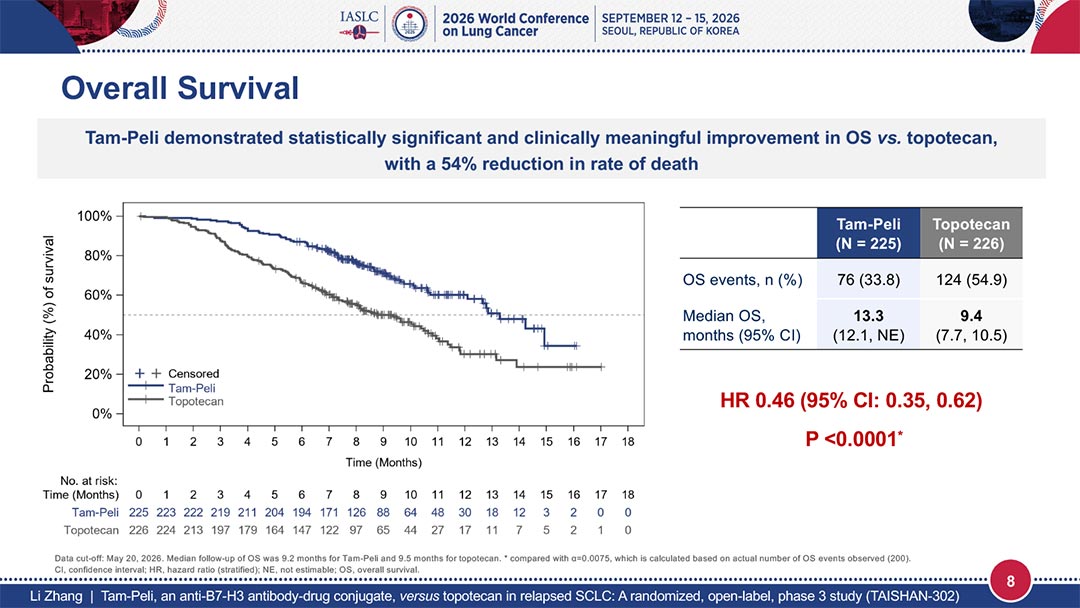
With a 54% reduction in death rate, tam-peli demonstrated a statistically significant and clinically meaningful improvement in OS compared with topotecan, with median OS: 13.3 months vs. 9.4 months. This OS benefit was consistent across all predefined subgroups, including patients with baseline brain metastases or different chemotherapy-free intervals.
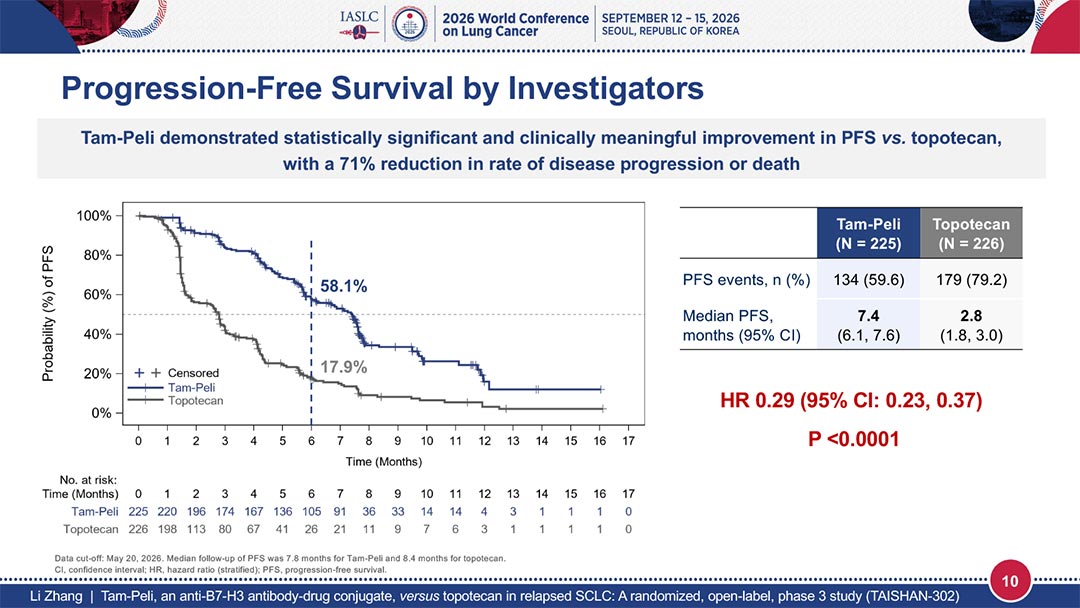
Tam-peli also showed a PFS benefit compared with topotecan (median PFS: 7.4 months vs. 2.8 months), with a 71% reduction in the rate of disease progression or death, consistent across subgroups. At six months, tam-peli yielded a 58.1% PFS rate, compared with 17.9% for the topotecan cohort.
The confirmed ORR was 59.1% for the tam-peli arm vs. 9.7% in the topotecan cohort. Additionally, tam-peli resulted in a DCR benefit compared with topotecan (91.1% vs. 50.9%).
The data indicate that tam-peli improved intracranial outcomes versus topotecan:
- Intracranial PFS: 6.1 months versus 4.2 months
- Intracranial cORR: 32.4% versus 2.9%
- Intracranial DCR: 90.5% versus 59.4%
Fewer grade 3 or higher treatment-related and serious treatment-related adverse events (TRAEs) were observed with Tam-peli than with topotecan 104 patients versus 162 patients and 58 versus 78 patients, respectively.
Additionally, there were no treatment-related deaths reported in the tam-peli cohort. Both the tam-peli and topotecan arms reported similar rates of all-grade TRAEs (221 tam-peli vs. 216 topotecan) and TRAEs leading to dose interruptions (78 patients vs. 80 patients).
The most common TRAEs were hematologic, with a lower incidence observed in the tam-peli arm. Treatment-related interstitial lung disease (ILD)/pneumonitis events occurred in 4.9% of patients in the tam-peli arm versus 1.4% in the topotecan arm. Grade 3 events occurred in 0.9% of patients in both treatment arms, and no grade 4 or 5 events were reported in either cohort.
“The results from the TAISHAN-302 study establish tam-peli—a B7-H3-targeting ADC—as a potential new standard of care for relapsed SCLC,” Dr. Zhang said.
While tam-peli demonstrated improvements in ORR, OS, and PFS, with a survival benefit observed across all subgroups, as well as robust intracranial activity in patients with brain metastases compared with topotecan, Anne C. Chiang, MD, PhD, in the discussion that followed, highlighted that there are some limitations of the study. In addition to being a China-only study, roughly 30% of patients in the study had no smoking history, something rarely seen in Western SCLC populations.
Dr. Chiang also commented that with the inevitable transition of tarlatamab—the currently approved second-line treatment in the United States—to the maintenance and first-line setting, ADCs like tam-peli would likely take its place in clinical practice.