

In the phase III REZILIENT 3 study, zipalertinib plus chemotherapy demonstrated a statistically significant improvement in progression-free survival (PFS) compared with chemotherapy alone in patients receiving first-line treatment for advanced non-small cell lung cancer (NSCLC) harboring EGFR exon 20 insertion mutations.
Daniel Shao-Weng Tan, BSc, MBBS, MRCP, PhD, a Senior Consultant Medical Oncologist at the National Cancer Center, Singapore, presented the findings during the second Presidential Symposium at the 2026 World Conference on Lung Cancer on September 14.

Presidential Symposium 2
Zipalertinib + Chemo in NSCLC with EGFR Exon 20 Insertions
Registered WCLC 2026 attendees can watch Presidential Symposium 2 with on-demand access to session recordings via the virtual platform. WATCH NOW
Zipalertinib is a tyrosine kinase inhibitor highly selective for EGFR exon 20 relative to wild-type EGFR. In early-phase trials, zipalertinib monotherapy demonstrated clinical activity, including efficacy in the central nervous system (CNS) and following amivantamab treatment. REZILIENT 3 wasa randomized global phase three study that followed a safety lead-in that confirmed that the zipalertinib plus chemotherapy combination was safe.

In REZILIENT 3, 279 patients with treatment-naïve metastatic NSCLC and locally confirmed EGFR exon 20 insertions were randomized 1:1 to zipalertinib 100 mg twice daily plus pemetrexed /platinum chemotherapy or to chemotherapy alone with optional crossover to zipalertinib at progression.
“I think there might be a lot of criticism on the control arm because currently this is not the standard of care, but I’d like to remind everybody that when the study was designed, platinum doublet was the standard of care in this patient population,” said discussant Lyudmila Bazhenova, MD, a board-certified medical oncologist and Professor of Medicine at UC San Diego Moores Cancer Center.
The primary endpoint was PFS assessed by blinded independent central review, and secondary endpoints included overall survival, investigator-assessed PFS, objective response rate (ORR), duration of response (DoR), safety, and patient-reported outcomes (PROs).
Nearly all patients exhibited adenocarcinoma histology, and notably, brain metastases were evenly distributed at approximately 31% in both groups, reflecting a real-world population where CNS involvement is frequently observed in this patient population.
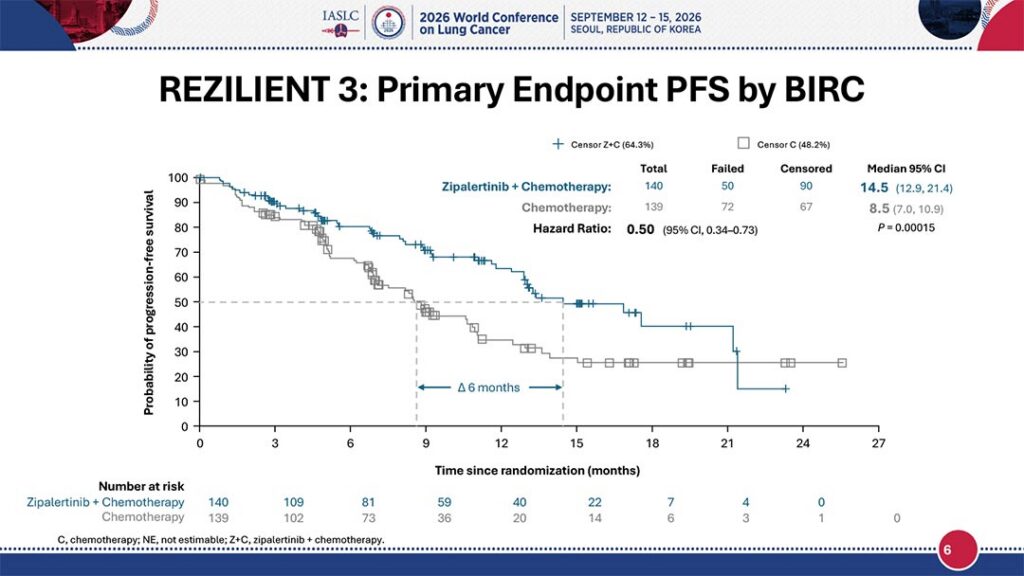
“REZILIENT 3 met its primary endpoint, with the zipalertinib and chemotherapy combination demonstrating statistically significant improvement in PFS compared with chemotherapy alone,” said Dr. Tan, a professor (tenure-track) at Duke-NUS Medical School and Senior Clinician-Scientist at the Genome Institute of Singapore. “Despite the control arm performing better than anticipated, the curve separated early and appeared to widen over time, with clear durable separation up to the 15-month mark at this pre-specified interim data cutoff.”
Median PFS was 14.5 months with zipalertinib plus chemotherapy versus 8.5 months with chemotherapy alone (HR, 0.50; 95% CI, 0.34-0.73; P=0.00015). PFS benefit was broadly consistent across pre-specified subgroups, including Eastern Cooperative Oncology Group (ECOG) performance status, gender, age, smoking history, and region.
“Notably, patients with baseline brain metastases that included untreated asymptomatic brain metastases less than 2 cm derived benefit with a hazard ratio of 0.38, supporting CNS activity as we had observed in the early phase studies,” Dr. Tan said.
ORR was significantly higher with zipalertinib plus chemotherapy (65% vs 40.3%, P<0.0001), and the disease control rate was 89.3% with the combination versus 81.3% with chemotherapy alone. The median duration of response was longer with zipalertinib plus chemotherapy (14.2 vs 9.9 months). Overall survival data remained immature at this interim analysis.
While treatment with the zipalertinib plus chemotherapy combination resulted in more grade ≥3 adverse events (87.1% vs 54.4%), Dr. Tan said they were largely manageable hematologic events. EGFR class effects were also observed with the combination, but these were generally manageable with interruptions and dose reductions, he said.