Consolidative durvalumab, given after chemoradiotherapy (CRT), remains the standard of care (SOC) for patients with unresectable stage III non-small cell lung cancer (NSCLC). Unfortunately, adding durvalumab concurrently with CRT and continuing it as consolidation in this setting failed to elicit any further overall survival (OS) benefit.
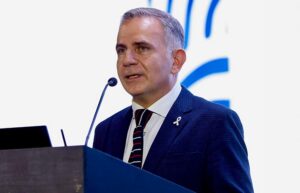
This was the main takeaway from the phase III EA5181 trial results, presented by John Varlotto, MD, professor of oncology and the chief of radiation oncology at Marshall University in Huntington, West Virginia.
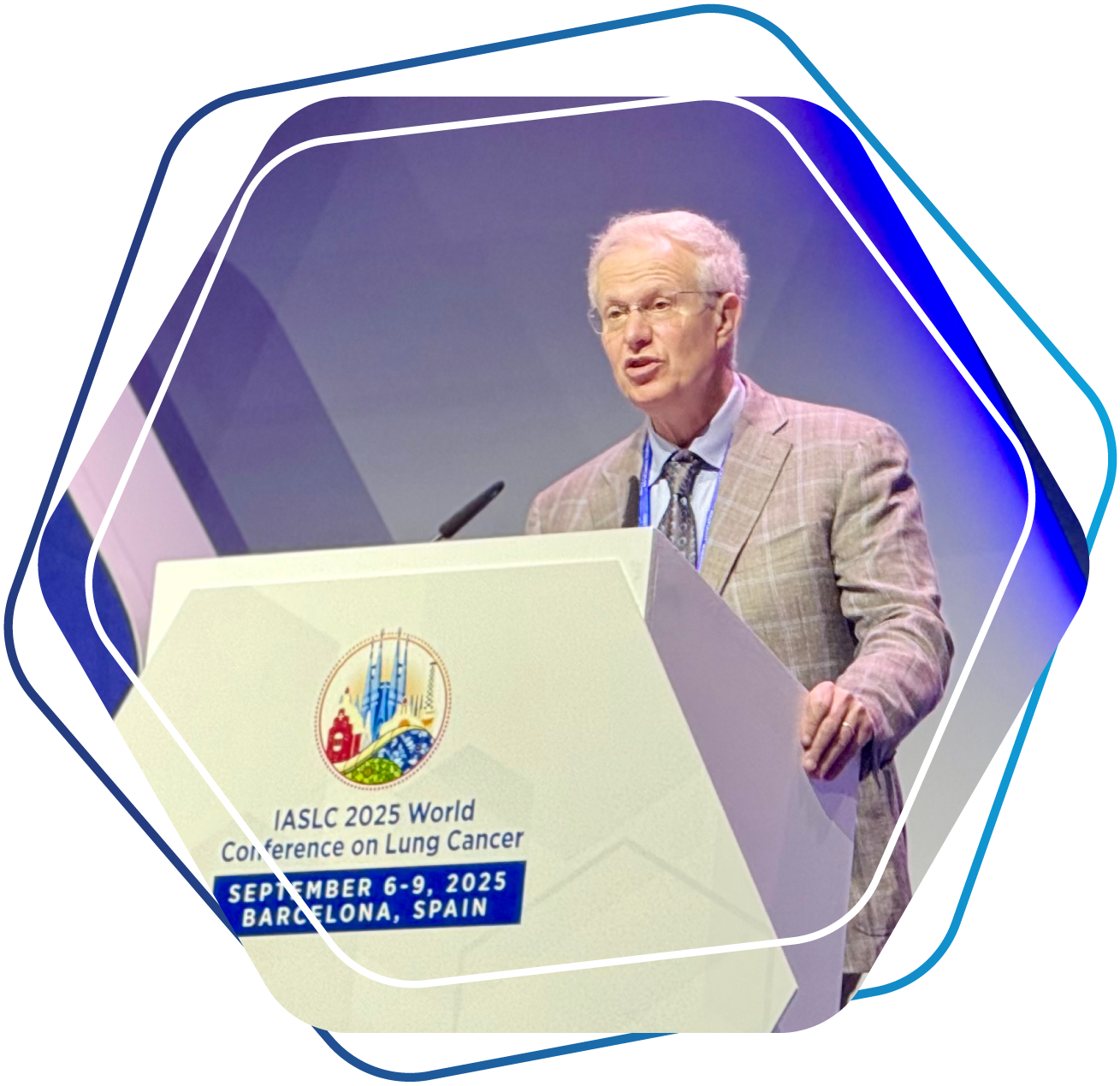
Presidential Symposium 2 with Lectureship Award Presentations
With on-demand access, registered WCLC 2025 attendees can still watch John Varlotto, MD, and other experts present much-awaited data during the second Presidential Symposia. Learn more
Dr. Varlotto framed the study rationale, stating, “The SOC [for unresectable stage III NSCLC] has been the PACIFIC trial,1 an uncontested regimen since it was FDA approved in 2018.” The PACIFIC trial strategy,1 wherein CRT is followed by durvalumab consolidation therapy for 1 year, demonstrated sustained and robust improvements in both OS and progression-free survival (PFS) over CRT alone.
The EA5181 study evaluated whether initiating durvalumab earlier, concurrently with CRT, and then continuing the immune checkpoint inhibitor as consolidation, could improve upon the survival benefit observed with durvalumab consolidation alone.
Overall, 662 treatment-naïve patients with unresectable stage III NSCLC were randomly assigned 1:1 to either concurrent durvalumab plus CRT or CRT alone. Patients in both arms who completed CRT and did not experience disease progression, pneumonitis, or significant toxicity then received durvalumab consolidation therapy for 1 year. Patients were stratified by sex, age, stage, and chemotherapy regimen.
The primary endpoint was OS in the intent-to-treat population; PFS, toxicity, overall response rates (ORRs), and recurrence patterns were key secondary endpoints.
The patient population was 60% male, 88% White, and 8.3% Black, with adenocarcinoma being the predominant histological subtype in nearly 49% of patients. Most patients (82.5%) in the study received carboplatin-paclitaxel as their chemotherapy regimen.
About 88% of patients in both treatment arms completed assigned treatments, with more than 90% completing CRT.
Regarding OS, Dr. Varlotto said, “There was absolutely no difference; the survival curves were superimposable.” The median OS was 41.5 months with concurrent and consolidative durvalumab, compared with 39.4 months with consolidation alone (p = 0.83; hazard ratio [HR] = 1.03). Similarly, there were no significant differences in PFS outcomes (median PFS: 15.5 months vs. 16.8 months; p = 0.65, HR = 1.05).
In early analyses of outcomes by subgroups, there were no significant differences between treatment arms, except for one subgroup: patients who received cisplatin-pemetrexed as their chemotherapy regimen had worse outcomes with the addition of concurrent durvalumab. However, the number of patients was small.
The two treatment arms yielded no differences in other secondary endpoints, including adverse events, recurrence patterns, and ORRs.
Notably, there were no differences in the median and mean cycles of consolidative durvalumab between the two arms, indicating that adding durvalumab during CRT did not compromise the patient’s ability to receive therapy during consolidation.
Dr. Varlotto said that future analyses are planned, including evaluation of cardiovascular and pulmonary toxicities, minimal residual disease, clonal hematopoiesis, local/distant recurrence factors, and radiation parameters.
Discussant Corinne Faivre-Finn, MD, PhD, professor of thoracic radiation oncology at the University of Manchester, highlighted the significant progress in outcomes for unresectable stage III NSCLC over the past four decades, culminating in the 66% 3-year survival seen in the PACIFIC trial.1 However, as 5-year OS is at best 43% and disease progression occurs within 2 years in over half of the patients, “there is room for improvement.”
Dr. Faivre-Finn called attention to the lack of a clear definition for “unresectable” disease and the “all-comer” nature of the trials, wherein patients were not selected based on PD-L1 status in either EA5181 and PACIFIC.1
Overall, the lack of benefit with concurrent immunotherapy, from EA5181 and other lung cancer studies in both NSCLC and limited-stage small cell lung cancer, suggests that “the immune system needs the right window,” Dr. Faivre-Finn said. She concluded that EA5181 provides a definitive answer regarding the lack of benefit of concurrent durvalumab, with the PACIFIC1 regimen remaining the SOC.
References:
- 1. Antonia SJ, Villegas A, Daniel D, et al. Durvalumab after Chemoradiotherapy in Stage III Non-Small-Cell Lung Cancer. N Engl J Med. 2017;377(20):1919-1929. doi:10.1056/NEJMoa1709937