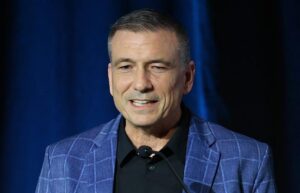






There is no way to prepare for a lung cancer diagnosis or any life-altering health issue. It doesn’t wait for your personal life to quiet down or for your schedule to clear. D. Ross Camidge, MD, PhD, has experienced this firsthand.

As the Director of the Thoracic Oncology Clinical Research Program at the University of Colorado, Dr. Camidge has dedicated much of his life to diagnosing and treating lung cancer. Following his lung cancer diagnosis in 2022, his experience shifted from professional to deeply personal.
During a special presentation at the 2026 Targeted Therapies for Lung Cancer (TTLC) meeting in Huntington Beach, California, Dr. Camidge detailed his journey from the onset of his initial symptoms to the decision to go public with his story.
He began by addressing the untimeliness of his diagnosis, which occurred while he was navigating significant personal challenges, including caring for his aging mother. What started as an ache in his left shoulder eventually developed into a “noise” when he exhaled, prompting him to seek further evaluation from his primary care physician.
“I mentioned with a smile that I was a thoracic oncologist and, while I was probably just being professionally paranoid, asked if it would be all right for me to have a chest X‑ray as well,” Dr. Camidge said. “He smiled back and crinkled his eyes indulgently. ‘Sure, just walk into radiology, and I’ll put the order in now.’”
The X-ray was followed by a CT scan after his physician reported that they had detected something abnormal.
“As soon as I got off the phone, I pulled up my own chest X-ray on my office computer. It looked like lung cancer,” Dr. Camidge said. “I don’t think I was surprised. I knew the noise I had heard [was consistent] with an obstruction.”
The initial CT scan revealed a mass in the right upper lobe, ipsilateral lymph nodes, bilateral lung deposits, and bone metastases. He was ultimately diagnosed with EGFR mutation positive non-small cell lung cancer (NSCLC). From there, he discussed the treatment plan and schedule with his wife and established his care team.
“People with a terminal disease are not just sitting around waiting to die. As we extend survival times, part of why we are here—all of us—is to redefine what it means to live, not just to die, with this disease.”
D. Ross Camidge, MD, PhD
A New Dynamic
Not ready to share his diagnosis with everyone, Dr. Camidge initially disclosed the news only to select team members, including his medical oncologist, radiation oncologist, a pulmonologist, a pathologist, and biopsy and molecular analysis specialists.
“I was used to running a professional team, and I relied on that professionalism to keep us all on track,” Dr. Camidge said. “For example, I didn’t tell our surgeons because I knew I wasn’t an operable candidate.”
He ultimately chose a colleague he had personally trained to be his oncologist, noting that they both understood this wouldn’t be a “normal” doctor-patient relationship.
“I remember him initially suggesting that we communicate about my case only through the patient portal, to which I replied, ‘You have the office next to mine. That is not going to happen,’” Dr. Camidge said. “I don’t direct my care, but I don’t deny my knowledge either. What was always a mentorship relationship based on peer‑to‑peer discussion has continued. One of the issues we discuss happens to be my own care.”
When Dr. Camidge decided to open up about his diagnosis, he was met with overwhelmingly positive reactions from both his colleagues and patients.
“I don’t entirely know what I expected, but the reaction from so many different groups was wonderful. I had worried about what my patients would think, but they were, of course, the most understanding—I’m walking in their shoes, after all,” Dr. Camidge said. “Pharma, academia, and clinical colleagues did exactly what I asked of them: they treated me the same.”
Leading by Example
While Dr. Camidge’s team was able to expedite his care through the “established” system, he recognizes the importance of using his platform to advocate for those who don’t necessarily have an “insider” perspective.
“What I took away from it was not the privilege of ‘you can do this if you’re an insider,’ but rather the realization that it was possible—and that part of what I might contribute was to emphasize to others that every patient could be [treated like this]. To present a challenge: to deliver the standard of care that they would want for themselves, to everyone, every day,” Dr. Camidge said.
He noted that while his diagnosis didn’t necessarily change how he cared for his patients, it did give him a greater appreciation for dealing with the existential stress of living with a terminal disease.
“Every good scan feels amazing, but they also leave some cumulative PTSD. Perhaps by calling this out and sharing the experience of being a patient, we insiders who share our experiences with you are here to keep us all focused on a singular fact: our trials, our research, our care are not directed at ‘patients,’ but at people with lives that lung cancer has gotten in the way of,” Dr. Camidge said.
Dr. Camidge also emphasized that a terminal diagnosis doesn’t mark the end of an individual’s aspirations or ambitions.
“People with a terminal disease are not just sitting around waiting to die. As we extend survival times, part of why we are here—all of us—is to redefine what it means to live, not just to die, with this disease,” Dr. Camidge said.
Future Directions
Looking forward, Dr. Camidge emphasized that progress in the field will involve much more than just new drugs and encouraged clinicians to lead by two guiding principles:
- Don’t underplay toxicities: Find better ways to present side effects meaningfully, allowing patients to plan their futures more accurately based on how the drug will affect their lives.
- Reframe efficacy: Consider whether the efficacy can be presented in a different way, as if a loved one were choosing between this drug and others, rather than focusing solely on its effectiveness alongside toxicity.
Reflecting on his journey and the lessons he has learned, Dr. Camidge expressed his gratitude to the oncology community for making a difference and called on them to continue advocating.
“This is a tough time to be a thinker, with reduced funding and increased clinical demands. But know one thing: your value, the reason you are here, is not just to offer up your patients to pharma and believe they have all the answers. Your value to the world is to add truth, to add independence,” Dr. Camidge said.