
In the phase III PAPILLON study, first-line amivantamab plus carboplatin-pemetrexed (amivantamab-chemotherapy) numerically extended median overall survival (OS) compared with chemotherapy alone in patients with treatment-naïve advanced non-small cell lung cancer (NSCLC) harboring EGFR exon 20 insertion (Ex20ins) mutations.
These findings were presented at the 2026 World Conference on Lung Cancer (WCLC) on Monday, September 14, during the second Presidential Symposium by Chul Kim, MD, MPH, Director of Thoracic Oncology at MedStar Georgetown University Hospital and Associate Professor at Georgetown University.
Amivantamab is an EGFR-MET bispecific antibody with immune cell-directing activity. Prior to amivantamab, median real-world OS for NSCLC with EGFR Ex20ins was approximately 16 to 24 months.

Presidential Symposium 2
Overall Survival from PAPILLION
Registered WCLC 2026 attendees can watch Presidential Symposium 2 with on-demand access to session recordings via the virtual platform. LEARN MORE
PAPILLON recruited 308 treatment-naïve patients with NSCLC and EGFR Ex20ins mutations. Of the 308 patients, 151 received amivantamab plus chemotherapy, and 155 received chemotherapy alone.
Because amivantamab’s second-line efficacy was already established when PAPILLON was designed, crossover from chemotherapy to second-line amivantamab was allowed after disease progression confirmed by blinded independent central review (BICR). Protocol-specified final OS was a key secondary endpoint.
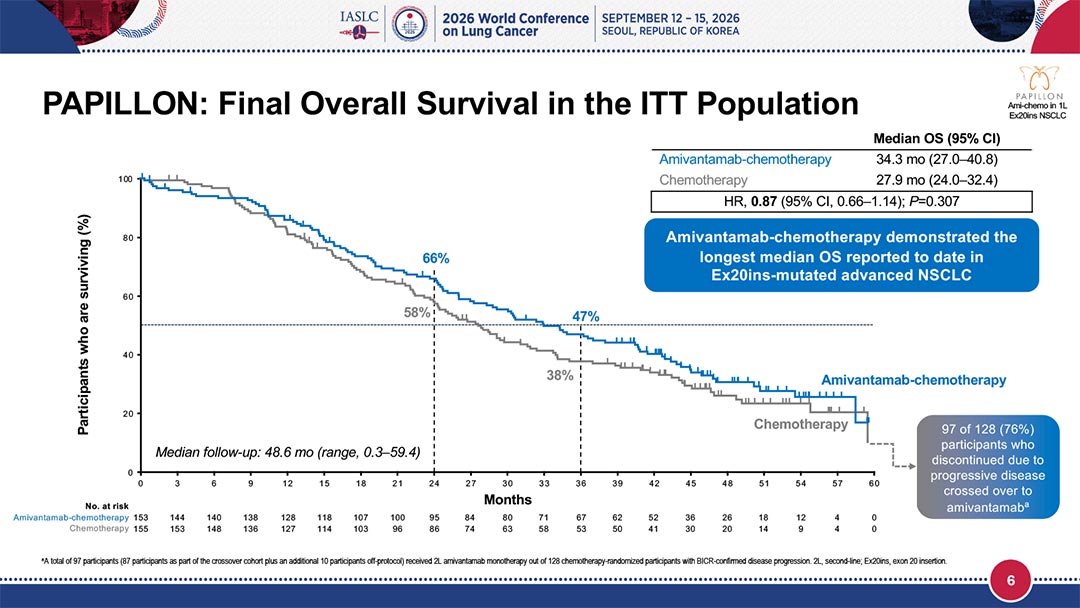
Amivantamab-chemotherapy numerically extended median OS by 6.4 months, reducing the risk of death by 13% (HR, 0.87; 95% CI, 0.66–1.14; p = 0.307). Statistical significance, however, was not achieved. Dr. Kim said that was in part because 76% of patients in the chemotherapy arm who discontinued treatment upon progression crossed over to second-line amivantamab.
He said that after adjusting for on-protocol crossover to amivantamab in the chemotherapy arm using an inverse probability of censoring weighting (IPCW) model, amivantamab-chemotherapy yielded an OS benefit compared with chemotherapy alone (HR, 0.57; nominal P=0.002).
Regarding subsequent therapy, 12% of patients in the amivantamab-chemotherapy group continued on first-line treatment, whereas 54% received further therapy. Most of these patients were treated with chemotherapy or immune checkpoint inhibitors, followed by other EGFR-targeted or TKI-based therapies.
In the chemotherapy arm, no patient remained on first-line chemotherapy, and 83% received subsequent therapy, with the majority receiving amivantamab.
Dr. Kim said amivantamab plus chemotherapy extended progression-free survival (PFS) from randomization to second progression event (PFS2) by more than 10 months; the median PFS2 was 28.3 months versus 17.5 months with chemotherapy alone.
The safety profile of amivantamab-chemotherapy was consistent with prior reports before subcutaneous amivantamab and prophylactic strategies, with no new safety signals identified. Most adverse events were grade one or two.
Patient-reported outcomes also favored the amivantamab-chemotherapy arm.
“Amivantamab plus chemotherapy prolonged time to worsening of symptoms versus chemotherapy. Time to worsening was significantly delayed for multiple domains, including pain and dyspnea,” Dr. Kim said. “Aligned with improved patient-reported outcomes, time to symptomatic progression was prolonged with amivantamab plus chemotherapy versus chemotherapy.”