
“We are now in the current era of immunotherapy [in small cell lung cancer (SCLC)],” said Anne Chiang, MD, PhD, Associate Professor of Medicine in the Section of Medical Oncology at Yale University, who discussed the data from the two very similar antibody-drug conjugate (ADC) trials in SCLC presented at the first Presidential Symposium of the 2026 World Conference on Lung Cancer (WCLC).
Dr. Chiang contextualized the ADC studies by reviewing the recent shift in the SCLC therapeutic paradigm, from one reliant on platinum-based chemotherapy and topotecan prior to 2019 to the immunotherapy-based approaches made possible by the introduction of immune checkpoint inhibitor-based regimens for maintenance and consolidation with the bispecific T-cell engager tarlatamab as a second-line option in extensive-stage SCLC (ES-SCLC).
Despite these advances, relapse occurs in a majority of patients with ES-SCLC, Dr. Chiang said, which highlights the urgent unmet medical need for effective therapies.
In this context, targeting SCLC surface antigens, such as B7-H3, with ADC-based approaches offers major therapeutic potential, Dr. Chiang explained.

Presidential Symposium 1
Riz-Rez vs. Topotecan in Relapsed SCLC
Registered WCLC 2026 attendees can watch Presidential Symposium 1 with on-demand access to session recordings via the virtual platform. LEARN MORE

Jie Wang, MD, lead author of ARTEMIS-008 and Chair of the Medical Oncology Division at the National Cancer Center, Cancer Hospital, Chinese Academy of Medical Sciences, explained the therapeutic rationale: “SCLC exhibits high expression of the immune checkpoint protein B7-H3, which is associated with reduced survival.”
The B7-H3-targeted ADC risvutatug rezetecan (riz-rez) previously demonstrated encouraging efficacy across multiple solid tumors, including heavily pretreated patients with ES-SCLC, in the ARTEMIS-001 study.
Seeking to extend these findings, ARTEMIS-008, an open-label, randomized, controlled phase III trial, was designed to compare riz-rez with topotecan in adults with SCLC whose disease relapsed or progressed after first-line platinum-based therapy.
Patients were randomly assigned in a 1:1 ratio to receive either riz-rez (n = 230) or topotecan (n = 231) until progression or other discontinuation criteria were met. The primary endpoint was overall survival (OS), and key secondary endpoints included progression-free survival (PFS) per blinded independent central review (BICR) and investigator assessment (IA), overall response rate (ORR), disease control rate (DCR), and duration of response (DoR) per BICR.
Stratification factors included chemotherapy-free interval (chemotherapy-free interval [CTFI]; less than 90 days vs. more than 90 days), baseline brain metastases (yes vs. no), and disease stage (limited-stage SCLC [LS-SCLC] vs. ES-SCLC).
Dr. Wang shared findings from the primary pre-planned interim analysis of ARTEMIS-008, which was performed after 75% of OS events (n = 192) had occurred.
Baseline characteristics were well balanced across the two treatment arms, with prior programmed death PD(L)-1 inhibitor therapy use in approximately 80% of patients, platinum-resistant disease (CTFI less than 90 days) in approximately 36% of patients, and baseline brain metastases in approximately 20% across both arms.
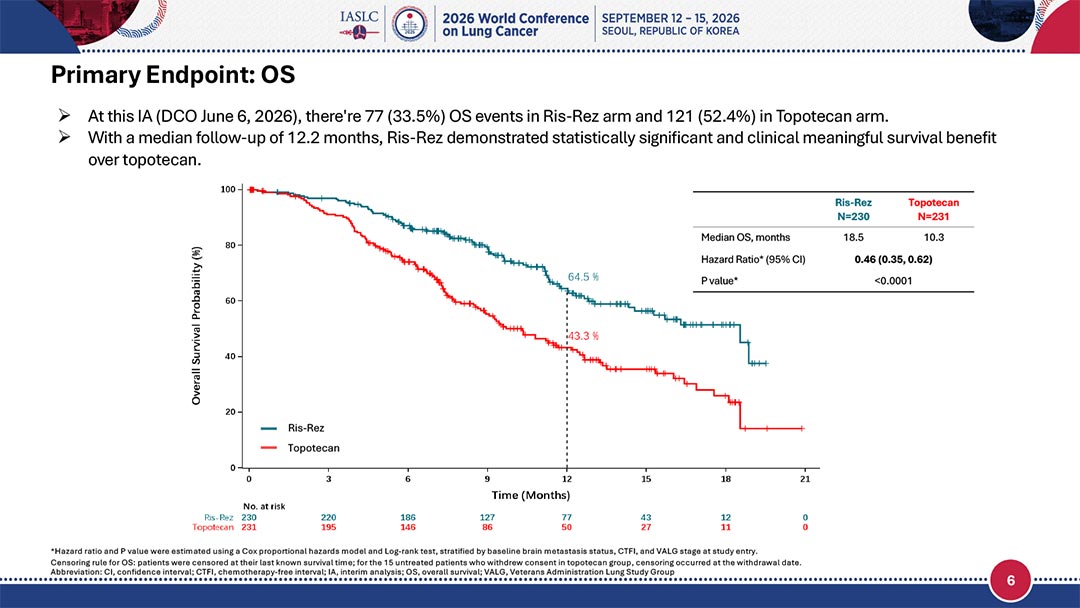
At a median follow-up of 12.2 months, the interim analysis showed a statistically significant and clinically meaningful improvement in OS with riz-rez compared with topotecan; the median OS was 18.5 months with riz-rez versus 10.3 months with topotecan (hazard ratio, 0.46; p < 0.0001).
“OS benefit was consistent across predefined subgroups,” Dr. Wang said, highlighting the OS improvement regardless of platinum-resistant/-sensitive disease or the presence or absence of brain metastases, “suggesting a positive signal for intracranial activity [of riz-rez].”
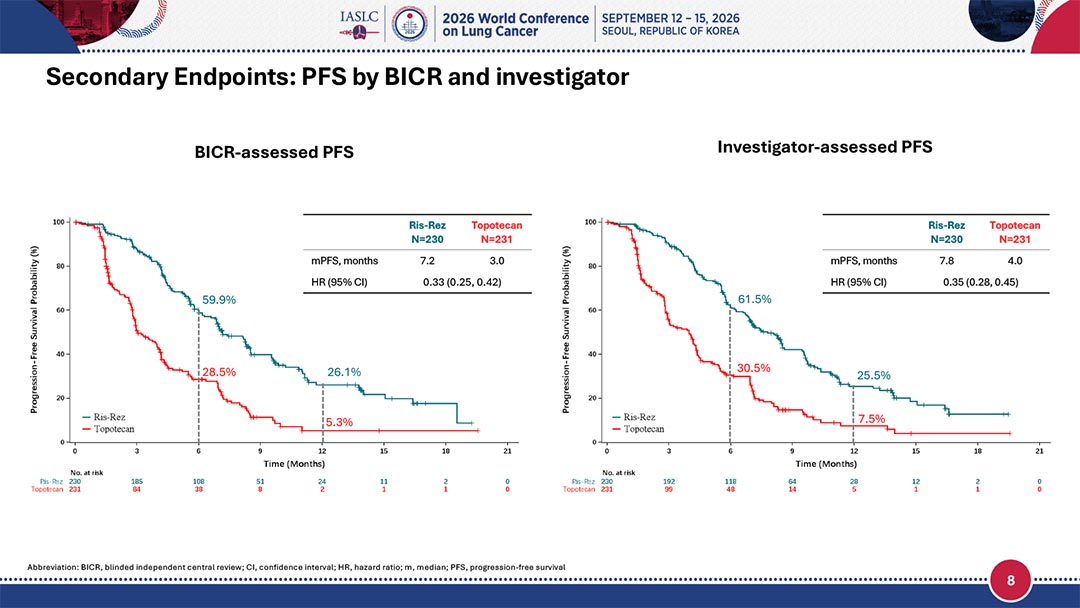
Riz-rez also demonstrated consistent benefit across secondary efficacy endpoints, including PFS per BICR and IA, ORR, DCR, and DoR per BICR.
Discussing the safety findings, Dr. Wang noted a lower rate of grade 3 or higher treatment-related adverse events (TRAEs) with riz-rez than with topotecan (60.9% vs. 78.2%), particularly the lower incidence of decreased platelet counts (13.9% vs. 59.7%). Although more interstitial lung disease (ILD) events were reported with riz-rez (11.7% vs. 1.9%), none were grade 4 or 5.
“The [ARTEMIS-008] trial positions riz-rez as a potential new standard of care for relapsed SCLC,” Dr. Wang concluded, alluding to an ongoing study of riz-rez in relapsed SCLC—the global phase III EMBOLD-SCLC-301.
In her discussion, Dr. Chiang, who also compared findings from both the TAISHAN-302 and ARTEMIS-008—both B7-H3-directed ADCs in relapsed SCLC—stated that, based on the presented results and other ongoing ADC studies in SCLC, “A new standard is emerging.”
Both TAISHAN-302 and ARTEMIS-008 showed significant PFS and OS benefits with ADC-based treatment compared with topotecan, including patients with platinum-resistant disease and brain metastases. However, the trials were limited to patients in China and a higher percentage of patients with no smoking history than in previous global trials, which may limit generalizability, Dr. Chiang noted.
“We are going to have a lot of options,” Dr. Chiang said, reviewing the rapidly expanding landscape of ADCs in SCLC. She added, “ADCs are not just chemo on a stick,” pointing out key aspects of ADC biology that may help clarify their optimal use and sequencing.
Dr. Chiang concluded with her predictions for the near future of SCLC management: ADCs are likely to become the second-line treatment of choice for relapsed SCLC, and ADCs may even replace chemotherapy in the frontline setting.
“We need to make way for sequencing therapies guided by tumor surface proteins and biologically distinct SCLC subtypes,” Dr. Chiang concluded.