

The disease-free survival (DFS) benefit seen in the global phase III ADAURA trial of adjuvant osimertinib therapy over 3 years led to regulatory approval of the first-ever adjuvant targeted therapy in early-stage resected non-small cell lung cancer (NSCLC) more than 5 years ago.

In addition to the primary endpoint of DFS in the primary population of patients with EGFR-mutated stage II–IIIA NSCLC, ADAURA included the key secondary endpoint of overall survival (OS) for the primary and overall (stage IB–IIIA NSCLC) populations.
Subsequent long-term follow-up analyses, reported in 2023, showed that the DFS benefit translated into an OS benefit, with a 5-year OS rate of 88% with osimertinib compared with 78% with placebo (hazard ratio, 0.49; p < 0.0001).
Adjuvant osimertinib is now the guideline-recommended standard of care for EGFR-mutated early-stage NSCLC.
Roy S. Herbst, MD, PhD, director of the Dartmouth Cancer Center, presented findings from an exploratory long-term OS analysis of ADAURA at the 8-year landmark. The data were presented during the second Presidential Plenary Session at the 2026 World Conference on Lung Cancer (WCLC) on September 14.

Presidential Symposium 2
ADAURA8-year Overall Survival Data
Registered WCLC 2026 attendees can watch Presidential Symposium 2 with on-demand access to session recordings via the virtual platform. LEARN MORE
The exploratory analysis included 431 patients with additional survival data, representing 77% of those alive at the time of the final OS analysis conducted in 2023; the remaining 127 (23%) were censored because additional survival data were not available after the final OS analysis.

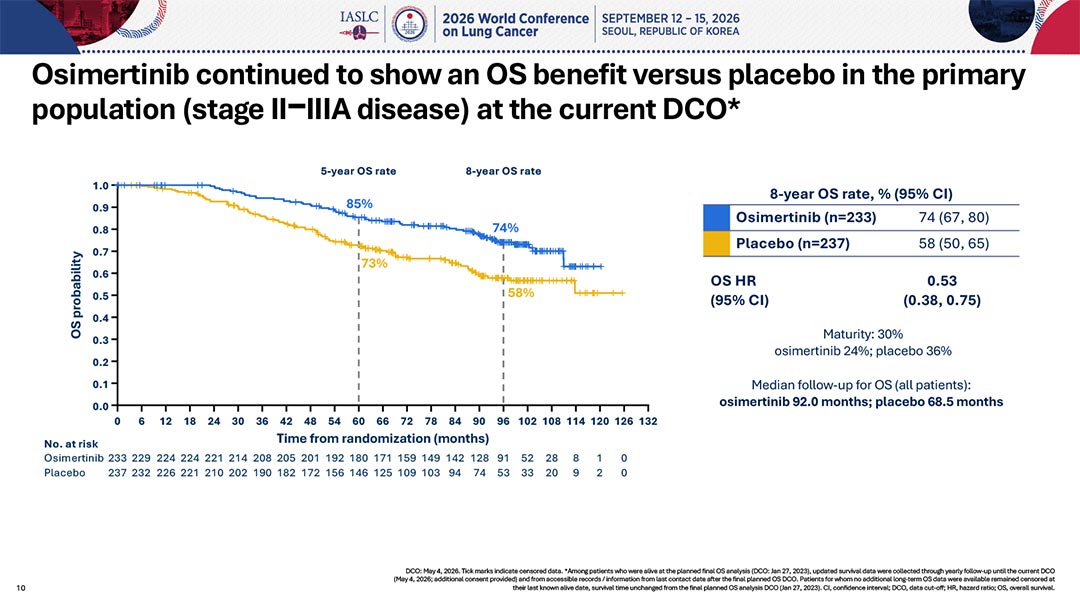
In patients with stage II-IIIA disease, the 8-year OS rate was 74% with osimertinib versus 58% with placebo; the hazard ratio was 0.53 (95% CI, 0.38–0.75). Osimertinib also yielded an OS benefit compared with placebo in the overall population with stage IB-IIIA NSCLC; the 8-year OS rate was 79% versus 64%, with a hazard ratio of 0.52 (95% CI, 0.39–0.71). Median OS was not reached for either population.
“We continue to see consistent OS benefit [with adjuvant osimertinib] versus placebo,” Dr. Herbst said.
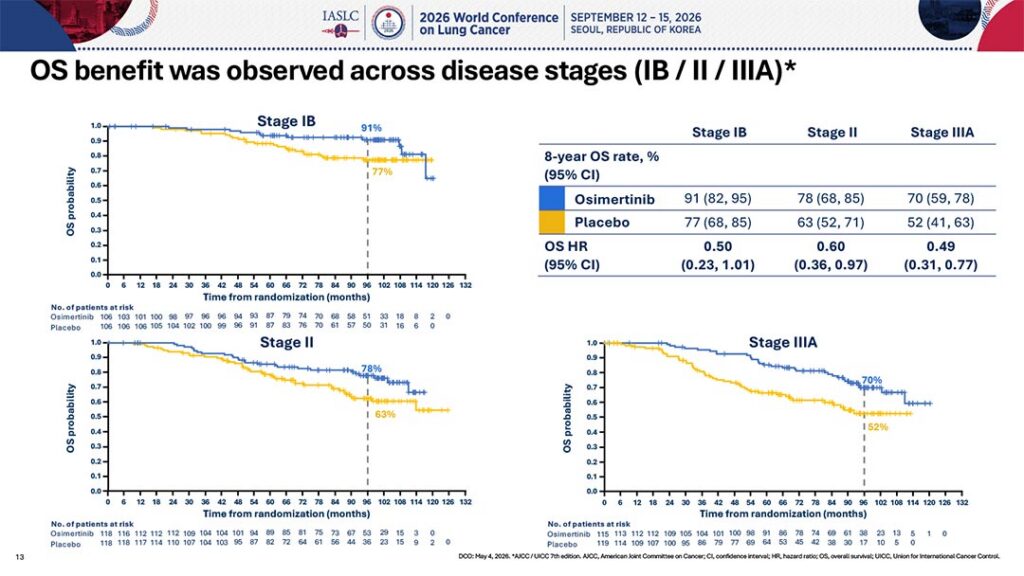
The OS benefit favored osimertinib over placebo across all predefined subgroups, including patients with and without smoking history, those under age 65 years and those 65 and older, across disease stages (stage IB, II, or IIA), and with either exon 19 deletions or L858R mutation in EGFR.
Osimertinib also improved OS versus placebo, regardless of whether patients received adjuvant chemotherapy. In ADAURA, 60% of patients received standard chemotherapy before randomization.
Dr. Herbst underscored the importance of EGFR testing in all patients with NSCLC.
“Patients need access to testing,” he said, adding that the long-term ADAURA data also support using the best targeted drugs earlier in the disease course to delay progression and improve survival in patients with early-stage NSCLC.
Discussing the findings, Antonio Passaro, MD, PhD, Director of the Division of Thoracic Oncology at the European Institute of Oncology in Milan, Italy, said, “ADAURA already answered the efficacy question. This new update confirms something different—specifically, the durability [of the OS benefit seen with adjuvant osimertinib].”
The 8-year OS update did not change the standard of care; instead, it substantiated the durability of the OS benefit, as there was no late convergence of OS curves between treatment arms, he said.
Moreover, the absolute OS gain widened over time, from more than 10% at 5 years to more than 15% at the 8-year landmark.
The next step in calibrating treatment is moving beyond DFS improvement and delayed recurrence to ascertaining persistent treatment benefit after stopping adjuvant osimertinib, Dr. Passaro said.
Dr. Passaro added that understanding the patterns, sites, and timing of disease recurrence after stopping adjuvant osimertinib is important to tailor the duration, type, and intensity of treatment and to consider potential rechallenge with osimertinib.
While minimal residual disease (MRD) status could ultimately inform treatment duration decisions, sufficient data are not yet available to determine candidacy for adjuvant treatment with a tyrosine kinase inhibitor based on MRD status, Dr. Passaro cautioned.
“The ADAURA standard is stronger again,” Dr. Passaro concluded, “OS benefits persist 5 years beyond the planned treatment completion.”
On the duration of osimertinib therapy, a real-world retrospective analysis presented during a poster session at the meeting showed that only one-third of patients treated in US academic and community oncology practice remained on osimertinib at 36 months, despite the ADAURA protocol stipulating a 3-year treatment course.
The updated ADAURA analysis was published today in the Journal of Thoracic Oncology, the official journal of IASLC. Dr. Herbst said a plain-language summary will be published soon.