
Kirsten rat sarcoma viral oncogene homolog (KRAS) was discovered as a human oncogene in 1982 and has remained an “undruggable” target for the past four decades due to the picomolar binding affinity for endogenous nucleotide ligands and the lack of a suitable binding pocket for inhibitors.1,2 The discovery that the switch-II pocket of the mutant KRAS G12C protein is druggable has shifted this paradigm.

Within eight years, sotorasib and adagrasib advanced from discovery to securing accelerated FDA approval for previously treated patients with KRAS G12C-mutated non-small cell lung cancer (NSCLC).3,4 The accelerated approval of these agents was based on phase I/II trials that used surrogate endpoints of objective response rate (ORR) and duration of response (DoR) in single-arm cohorts.5,6
The confirmatory phase III trials demonstrated improvements in ORR and median progression-free survival (mPFS) compared to docetaxel in previously treated KRAS G12C-mutated NSCLC: 5.6 months versus 4.5 months for sotorasib (ORR 28.1%; hazard ratio [HR] of PFS 0.61) and 5.5 months versus 3.8 months for adagrasib (ORR 32%; HR of PFS 0.58).7,8
These meaningful but modest improvements need to be weighed against the relative toxicities associated with sotorasib, adagrasib, and docetaxel, as the KRAS G12C inhibitors are generally better tolerated than docetaxel. Advancing these and similar agents to the frontline—where tumor biology, performance status, and immune competence are more favorable—will likely be necessary to maximize their therapeutic potential.
At the 2026 ASCO (American Society of Clinical Oncology) Annual Meeting in Chicago, data from early- and late-phase clinical trials for several KRAS inhibitors were presented, highlighting the potential to shift the current frontline treatment paradigm.
Frontline Treatment Options
Pembrolizumab monotherapy, or in combination with platinum-containing chemotherapy, is the current frontline standard of care for patients with advanced KRAS G12C-altered NSCLC, with a median overall survival (OS) of around 18 months.9,10 Recent real-world data suggest that these outcomes may be even worse than those observed in randomized trials, with median OS for immunotherapy monotherapy in the PD-L1 ≥ 50% population ranging from 20 to 22 months, and only 13 to 16 months in all patients treated with chemoimmunotherapy.
Only 38% of these patients received a second therapy. Additionally, patients with KRAS alterations often have co-mutations in STK11 (~ 30%) and KEAP1 (~ 20%), which attenuate the efficacy of existing therapies.11
Since mutant KRAS signaling affects the tumor immune microenvironment, and preclinical models have consistently demonstrated that KRAS G12C inhibitors enhance immune-mediated tumor clearance, there is a strong rationale for using frontline KRAS G12C blockade in combination with immunotherapy.12,13
Monotherapy with KRAS G12C Inhibitors

Emerging data on next-generation KRAS G12C inhibitors—including OFF-state agents such as olomorasib, divarasib, and elisrasib, alongside ON- and ON/OFF-state inhibitors—continue to expand the monotherapy landscape for patients with advanced NSCLC harboring a KRAS mutation.
A growing number of agents are now in various stages of clinical development. Most agents have demonstrated an ORR in the range of 30% to 60%, though cross-trial comparisons are limited due to small sample sizes and heterogeneous populations, including differing proportions of patients with untreated brain metastases and of patients who are KRAS G12C inhibitor-naïve versus previously treated with KRAS G12C inhibitors.
Treatment-related adverse events (TRAEs), such as nausea, vomiting, hepatotoxicity, and rash, are ubiquitous. However, full characterization at the recommended phase II and phase III doses is still needed, and the current safety profiles should be interpreted with that caveat in mind.
Elisrasib is an OFF-state inhibitor specifically designed to achieve rapid target engagement and outpace nucleotide exchange—a kinetic advantage that translates into greater suppression of the KRAS pathway. At the ASCO 2026 meeting, Lu et al. presented results from a phase I/II trial demonstrating a 58% ORR and a mPFS of 12.2 months in previously treated, KRAS G12C inhibitor-naïve patients with NSCLC, and a 32.3% ORR and an 8.1-month mPFS in KRAS G12C inhibitor-refractory patients.14
Elisrasib demonstrated activity against both previously treated and untreated brain metastases. The treatment was generally well tolerated, with grade ≥ 3 TRAEs occurring in 14.6% of patients.
Remarkably, this agent demonstrated a 78% ORR as monotherapy in the treatment-naïve setting. If the ORR, PFS, and OS data are validated in larger studies, it could lead to the approval of elisrasib monotherapy in the first-line setting.
The favorable safety profile of these next-generation KRAS inhibitors, including low rates of hepatitis, has enabled the development of various combination therapies with immunotherapy and chemoimmunotherapy.
Combination Therapy with KRAS G12C Inhibitors
At ASCO, new data were presented assessing several KRAS G12C inhibitors, including olomorasib, divarasib, and elisrasib, in combination with pembrolizumab. Previous findings from LOXO-RAS-20001—a phase I/II trial evaluating the combination of olomorasib with pembrolizumab for patients with KRAS G12C NSCLC—demonstrated an ORR of 57.1%. This included 73.9% in treatment-naïve patients, 48.1% in those previously treated with chemotherapy and/or immunotherapy, and 27.8% in patients with prior chemotherapy or immunotherapy and KRAS G12C inhibitors.15
Treatment responses occurred regardless of PD-L1 expression levels and the presence of STK11 or KEAP1 mutations. Grade 3 or higher TRAEs were observed in 44% of patients, with about 11.8% of patients discontinuing treatment due to toxicity.15,16 Notably, grade 3 hepatitis was relatively uncommon, managed with dose interruptions or corticosteroids, and did not affect the durability of the response.
At ASCO 2026, a combined dataset from LOXO-RAS-20001 and the 100-patient dose-optimization/safety run-in from SUNRAY-01—a phase III trial evaluating olomorasib in combination with immunotherapy and/or chemotherapy—was presented. Data presented at the 2025 World Conference on Lung Cancer demonstrated an ORR of 73% for all patients and 78% in patients with PD-L1 expression of ≥ 50%.17
PD-L1 status seemed to have little influence on outcome. Objective response rates (ORR) for PD-L1 ≤ 50%, PD-L1 1%–49%, and PD-L1 ≤ 1%, were 63.3%, 66.7%, and 63.3%, respectively.18 No new or unexpected toxicities were observed, even among patients who had previously received a cycle of standard-of-care treatment.
During ASCO 2026, Skoulidis and colleagues presented results from Krascendo 170, an open-label phase Ib/II study investigating divarasib in combination with pembrolizumab in patients with previously untreated KRAS G12C-mutated metastatic NSCLC. This combination demonstrated an ORR of 73% and an mPFS of 19.3 months in the PD-L1-positive population.19
Responses were noted even in patients with low PD-L1 expression levels and KEAP1 or STK11 mutations. A promising, unconfirmed ORR of 69.7% was observed in the PD-L1-negative population. Patients receiving this combination treatment experienced significantly higher TRAEs.
Grade 3 or 4 TRAEs occurred in 65.4% of patients; 52.6% required divarasib dose reduction, 69.2% experienced divarasib dose interruptions, and 12.8% discontinued treatment.19 The most common adverse events were diarrhea, nausea, vomiting, and elevated liver function enzymes. Elevated liver enzymes have also been observed with other KRAS inhibitors and immunotherapy combinations.
To mitigate this transaminitis, prophylactic dexamethasone before, during, and after the co-administration of divarasib and pembrolizumab is being implemented in the ongoing Krascendo2 trial. This phase III study is evaluating divarasib in combination with pembrolizumab in the frontline setting.
Finally, Lu et al. reported preliminary results for elisirib combined with pembrolizumab, demonstrating an impressive ORR of 81.3%. Notably, the ORR reached 95% among patients with PD-L1 expression of ≥ 50%. Additionally, 32.7% of participants experienced grade ≥ 3 TRAEs, including one fatal case of myocarditis-ILD.14
Approximately 40% of patients experienced elevated liver function enzymes, with about 6% showing grade ≥ 3 elevations. Elisrasib dose interruptions occurred in 50% of patients, with 23.1% reporting dose reductions and 1.9% discontinuing treatment due to toxicities.14 Of note, this trial was largely conducted in China with predominantly Asian patients, so its generalizability to US and European populations remains to be confirmed.
Overall, these studies compare favorably with other recently presented studies combining a next-generation KRAS G12C inhibitor with pembrolizumab; as such, an approved combination will likely be available in the coming years 20,21 (Table 1).
Beyond G12C and NSCLC: The Broader KRAS Landscape
KRAS G12C accounts for approximately 13% of NSCLC cases. Data presented at ASCO 2026 highlight new agents targeting the KRAS G12D mutation in NSCLC, as well as multiple KRAS mutations in pancreatic adenocarcinoma.
TSN1611, a small-molecule inhibitor targeting both the ON and OFF states of the KRAS G12D protein, demonstrated a 42.9% ORR and a 100% disease control rate in patients with NSCLC.22 No dose-limiting toxicities were reported in this phase I trial, with nausea, vomiting, diarrhea, anemia, and elevated liver function enzymes being the most common adverse events.
This complements the promising data previously presented at AACR (American Association for Cancer Research) 2026 regarding the RAS-ON G12D inhibitor, zoldonrasib, which demonstrated an ORR of 52%, a disease control rate (DCR) of 93%, and a mPFS of 11.1 months in previously treated patients with NSCLC harboring the KRAS G12D mutation.23
In metastatic pancreatic cancer, Walpin et al. reported the results of the phase III RASolute 302 trial. This study compared daraxonrasib—an oral inhibitor of KRAS ON-state targeting mutations at G12, G13, and Q61—with investigator’s choice of chemotherapy in patients with previously treated metastatic pancreatic cancer.24 Daraxonrasib led to improvements in mPFS (7.2 months vs. 3.6 months; HR 0.49; p < 0.0001) and mOS (13.2 vs. 6.6 months; HR 0.4; p < 0.001) compared to chemotherapy.25 Grade ≥ 3 TRAEs occurred in 61.8% of patients, with 1.2% reporting daraxonrasib treatment discontinuation.
This practice-changing study received a standing ovation at the ASCO 2026 plenary session and highlights the potential of KRAS inhibitors to improve patient outcomes. These outcomes parallel early data in thoracic oncology from a phase I trial (NCT05379985), where daraxonrasib yielded a mPFS of 9.8 months and a mOS of 17.7 months in previously treated KRAS G12X NSCLC.
Conclusion
In 2020, the central question in the field was whether a G12C inhibitor would be approved. Six years later, that question has been answered: Two agents are approved, and multiple next-generation inhibitors spanning RAS-OFF, RAS-ON, and RAS ON/OFF mechanisms, as well as selective G12D inhibitors, are now entering clinical trials.
The phase III readouts from SUNRAY-01, Krascendo 2, and other studies expected over the next two years will determine the next treatment paradigm for patients with NSCLC harboring KRAS G12C alterations. Beyond G12C, the emergence of G12D, G12X, and pan-RAS inhibitors further extends this trajectory, with the potential to transform the treatment landscape for patients with KRAS mutations across the board..
The question is no longer about the efficacy of KRAS-directed therapy but rather its optimization: Which mechanism best fits which patient, in which combination, and in what sequence?
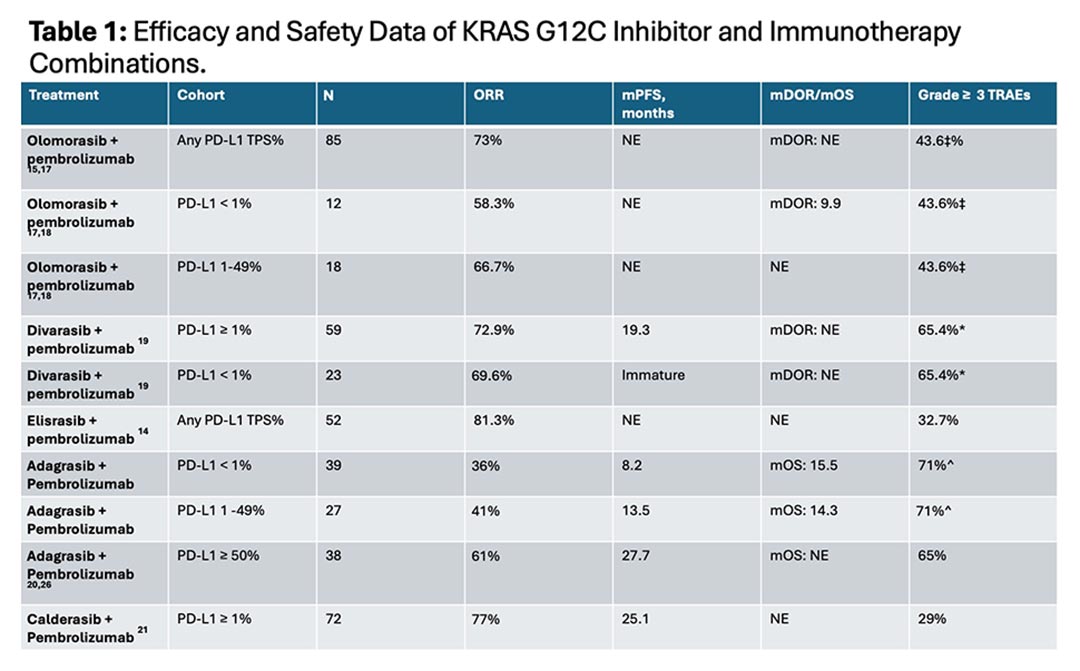
ORR: overall response rate; mPFS: median progression-free survival; mDOR: median duration of response; mOS: median overall survival; TRAEs: treatment-related adverse events; NE: not estimable; ‡ – entire population (n=85); * – entire population (n =78); ^ – entire population (n = 149)
References
- 1. Agoni, C., Olotu, F. A., Ramharack, P. & Soliman, M. E. Druggability and drug-likeness concepts in drug design: are biomodelling and predictive tools having their say? J Mol Model 26, 120 (2020). https://doi.org/10.1007/s00894-020-04385-6
- 2. Der, C. J., Krontiris, T. G. & Cooper, G. M. Transforming genes of human bladder and lung carcinoma cell lines are homologous to the ras genes of Harvey and Kirsten sarcoma viruses. Proc Natl Acad Sci U S A 79, 3637-3640 (1982). https://doi.org/10.1073/pnas.79.11.3637
- 3. Nakajima, E. C. et al. FDA Approval Summary: Sotorasib for KRAS G12C-Mutated Metastatic NSCLC. Clin Cancer Res 28, 1482-1486 (2022). https://doi.org/10.1158/1078-0432.CCR-21-3074
- 4. Dhillon, S. Adagrasib: First Approval. Drugs 83, 275-285 (2023). https://doi.org/10.1007/s40265-023-01839-y
- 5. Skoulidis, F. et al. Sotorasib for Lung Cancers with KRAS p.G12C Mutation. N Engl J Med 384, 2371-2381 (2021). https://doi.org/10.1056/NEJMoa2103695
- 6. Janne, P. A. et al. Adagrasib in Non-Small-Cell Lung Cancer Harboring a KRAS(G12C) Mutation. N Engl J Med 387, 120-131 (2022). https://doi.org/10.1056/NEJMoa2204619
- 7. de Langen, A. J. et al. Sotorasib versus docetaxel for previously treated non-small-cell lung cancer with KRAS(G12C) mutation: a randomised, open-label, phase 3 trial. Lancet 401, 733-746 (2023). https://doi.org/10.1016/S0140-6736(23)00221-0
- 8. Barlesi, F. et al. Adagrasib versus docetaxel in KRAS(G12C)-mutated non-small-cell lung cancer (KRYSTAL-12): a randomised, open-label, phase 3 trial. Lancet 406, 615-626 (2025). https://doi.org/10.1016/S0140-6736(25)00866-9
- 9. Garassino, M. C. et al. Pembrolizumab Plus Pemetrexed and Platinum in Nonsquamous Non-Small-Cell Lung Cancer: 5-Year Outcomes From the Phase 3 KEYNOTE-189 Study. J Clin Oncol 41, 1992-1998 (2023). https://doi.org/10.1200/JCO.22.01989
- 10. Velcheti, V. et al. 5-Year Real-World Outcomes With Frontline Pembrolizumab Monotherapy in PD-L1 Expression >/= 50% Advanced NSCLC. Clin Lung Cancer 25, 502-508 e503 (2024). https://doi.org/10.1016/j.cllc.2024.05.002
- 11. Papillon-Cavanagh, S., Doshi, P., Dobrin, R., Szustakowski, J. & Walsh, A. M. STK11 and KEAP1 mutations as prognostic biomarkers in an observational real-world lung adenocarcinoma cohort. ESMO Open 5 (2020). https://doi.org/10.1136/esmoopen-2020-000706
- 12. Canon, J. et al. The clinical KRAS(G12C) inhibitor AMG 510 drives anti-tumour immunity. Nature 575, 217-223 (2019). https://doi.org/10.1038/s41586-019-1694-1
- 13. Hirade, K. et al. Inhibiting KRAS with CD47 and immune checkpoint overcomes intrinsic resistance to combined KRAS and immune checkpoint inhibitor therapy. Cell Rep Med 6, 102317 (2025). https://doi.org/10.1016/j.xcrm.2025.102317
- 14. Lu, S. et al. Elisrasib (D3S-001), a next-generation GDP-bound KRAS G12C inhibitor, as first-line therapy for <i>KRAS</i> G12C mutation–positive non– small cell lung cancer (NSCLC). Journal of Clinical Oncology 44, 8511-8511 (2026). https://doi.org/10.1200/JCO.2026.44.16_suppl.8511
- 15. Burns, T. F. et al. Efficacy and Safety of Olomorasib in Combination With Pembrolizumab in Treatment of Patients With KRAS G12C-Mutant Advanced NSCLC. J Thorac Oncol 21, 103528 (2026). https://doi.org/10.1016/j.jtho.2025.11.018
- 16. Burns, T. F. et al. 1L olomorasib plus pembrolizumab +/- chemotherapy in KRAS G12C-mutant NSCLC patients +/- a prior cycle of SOC: Results from LOXO-RAS 20001 and SUNRAY-01. Journal of Clinical Oncology 44, 8570-8570 (2026). https://doi.org/10.1200/JCO.2026.44.16_suppl.8570
- 17. Johnson, M. L. et al. MA02.06 Efficacy and Safety of 1L Olomorasib Plus Pembrolizumab in KRAS G12C-Mutant NSCLC: Results From LOXO-RAS-20001 and SUNRAY-01. Journal of Thoracic Oncology 20 (2025). https://doi.org/10.1016/j.jtho.2025.09.109
- 18. Chan, B. A. et al. First-line (1L) olomorasib + pembrolizumab in patients with <i>KRAS</i> G12C–mutant advanced NSCLC, and PD-L1 expression 0-49%, from the dose optimization cohorts of LOXO-RAS-20001 and SUNRAY-01. Journal of Clinical Oncology 44, 8628-8628 (2026). https://doi.org/10.1200/JCO.2026.44.16_suppl.8628
- 19. Skoulidis, F. et al. First-line (1L) divarasib plus pembrolizumab (pembro) in advanced or metastatic <i>KRAS </i>G12C+ non– small cell lung cancer (NSCLC): Results from the Krascendo-170 study. Journal of Clinical Oncology 44, 8510-8510 (2026). https://doi.org/10.1200/JCO.2026.44.16_suppl.8510
- 20. Garassino, M. C. et al. 5MO: First-line adagrasib (ADA) with pembrolizumab (PEMBRO) in patients (pts) with advanced/metastatic KRASG12C-mutated non-small cell lung cancer (NSCLC) and PD-L1 ≥50% from the phase II portion of KRYSTAL-7. Journal of Thoracic Oncology 20, S8-S10 (2025). https://doi.org/10.1016/s1556-0864(25)00200-x
- 21. Sacher, A. G. et al. MK-1084 for KRAS G12C-mutated (mut) metastatic non–small-cell lung cancer (mNSCLC): Results from KANDLELIT-001. Journal of Clinical Oncology 43, 8605-8605 (2025). https://doi.org/10.1200/JCO.2025.43.16_suppl.8605
- 22. Li, J. et al. Updated results of the phase 1/2 study of TSN1611, a highly selective KRAS G12D inhibitor, in patients with advanced solid tumors. Journal of Clinical Oncology 44, 710-710 (2026). https://doi.org/10.1200/JCO.2026.44.2_suppl.710
- 23. Riess, J. et al. Abstract CT021: Preliminary safety and clinical activity of zoldonrasib (RMC-9805), an oral, RAS(ON) G12D-selective, tri-complex inhibitor in patients with previously treated KRAS G12D non-small cell lung cancer (NSCLC). Cancer Research 86, CT021-CT021 (2026). https://doi.org/10.1158/1538-7445.Am2026-ct021
- 24. Wolpin, B. M. et al. Daraxonrasib, a RAS(ON) multi-selective inhibitor vs chemotherapy in previously treated metastatic pancreatic adenocarcinoma (mPDAC): Primary and final analysis from the phase 3 RASolute 302 study. Journal of Clinical Oncology 44 (2026). https://doi.org/10.1200/JCO.2026.44.17_suppl.LBA5
- 25. O’Reilly, E. M. et al. Daraxonrasib or Chemotherapy in Previously Treated Metastatic Pancreatic Cancer. N Engl J Med (2026). https://doi.org/10.1056/NEJMoa2605555
- 26. Jänne, P. A. et al. First-line adagrasib (ADA) with pembrolizumab (PEMBRO) in patients (pts) with advanced/metastatic KRAS<sup>G12C</sup>-mutated non-small cell lung cancer (NSCLC) from the phase 2 portion of the KRYSTAL-7 study. Journal of Clinical Oncology 43, 8500-8500 (2025). https://doi.org/10.1200/JCO.2025.43.16_suppl.8500